PORTA PIA
Nomentana was said in ancient times that door, then it was said of S. Agnese for the nearby church of said Santa, but now we call it Porta Pia, because by Pius IV it was adorned with the design by the famous Buonarroti; but having remained imperfect, it was then continued by Cav. Bernini, who did not even finish it. To the left of this gate was the ancient and famous Castro Pretorio, and next to the Vivario, seeing the walls still stretched out, and 4 miles far from the city was the famous villa of Faonte freed of Nero, in which he killed himself .â € ?? Giuseppe Vasi, Historical index of the great prospect of Rome - Educational itinerary, 1765
Between 1561 and 1565 the ancient Porta Nomentana was replaced by Porta Pia which, located on the square of the same name, is one of the 18 gates inserted in the defensive walls of the Aurelian Walls.
Pope Pius IV Medici entrusted the design work to Michelangelo. The door was one of the last architectural works of the great artist. After his death, which took place in 1564, in fact, the project was taken over by the architect Giacomo Del Duca.
The unique style of Porta Pia is poised between the classical trends of the late Renaissance and the new aspirations of the Baroque, the designs of the attic and of the external facade that opens towards Via Nomentana date back to the nineteenth century and are not connected to the Michelangelo's project.
A small curiosity is linked to the decoration of the internal facade: the patens (the small plates used in the Eucharistic celebration during Mass) surrounded by a stole and with a marble cube in the center recall the barber basins of the time with a towel around and a bar of soap in the center. According to legend, Michelangelo wanted to allude to the origins of Pius IV Medici, not dating back to the famous Florentine family, but a simple descendant of Milanese barbers. Despite this, the pope still had the permission to raise the Medici insignia and, given the deep bond that united the Medici house to Michelangelo, the latter wanted to "take revenge" in this way.
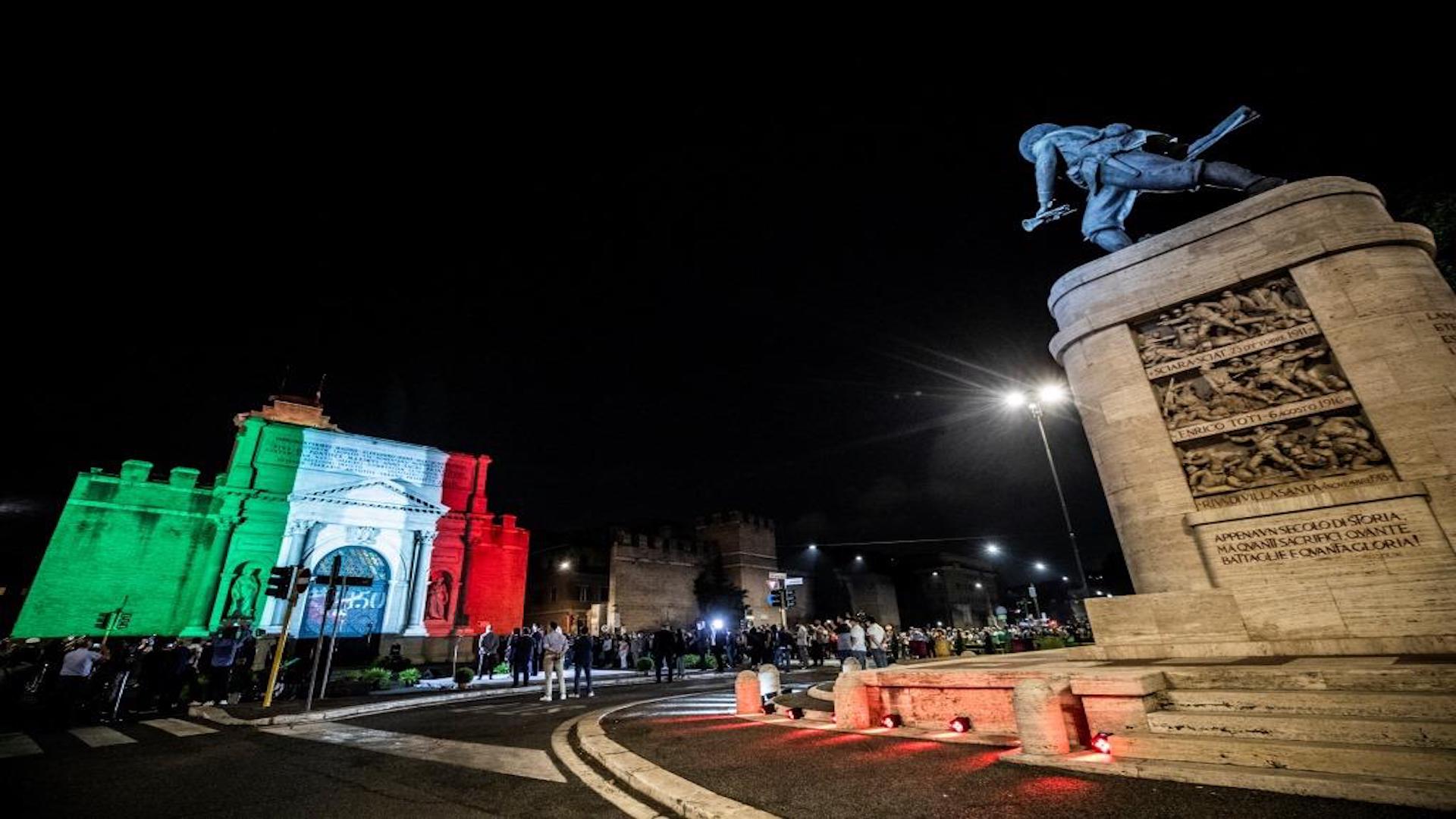
In modern times, the door is linked to an epochal event in Italian history. On September 20, 1870, at 9 in the morning, Raffaele Cadorna's signal rang out: the din of cannon fire and the sound of the collapse of the stretch of walls a few tens of meters from Porta Pia, the famous Breccia, first act spread in the air. of the victorious battle of the troops of the Kingdom of Italy on the Papal State and of the consequent capture of Rome, thus returned to Italy. A marble monument from 1920, and a commemorative column, commemorate the event. The signs of the fighting on part of the Aurelian Walls and on the door itself are still visible today. Outside the gate, in the middle of the square of Porta Pia, in 1932 the Monument to the Bersagliere was placed, the work of the sculptor Publio Morbiducci.
HISTORICAL MUSEUM OF THE BERSAGLIERI
Between the two facades that make up the door, connected by small buildings originally having a defensive function, there is a small courtyard which is now the seat of the Historical Museum of the Bersaglieri, inaugurated on 18 September 1932, which preserves relics and memories relating to the institution and the evolution of the Bersaglieri corps. In the courtyard of the Museum there are bronze busts of the most illustrious representatives of the Corps, including that of Enrico Toti, hero of the Risorgimento. In the Hall of Honor among the various precious relics there is the original Proposition, a handwritten written by La Marmora to obtain the constitution of the Corps from King Carlo Alberto. The ground floor houses the Memorial dedicated to the over one hundred thousand fallen for the homeland. At the center of the room is the saber that La Marmora wielded on 8 April 1848 in Goito. In the rooms on the first floor are exhibited the relics, such as uniforms, firearms and sidearms, the documents and memories relating to the Risorgimento campaigns, from 1848 to 1866. The upper floor is dedicated to the colonial campaigns, from the first landing of the Bersaglieri to Massawa, February 5, 1885, to the conquest of East Africa, in 1936. The lower floor is dedicated to the First World War with plaques, photographs, department flags, commemorative statues, portraits and medals of simple commanders and bersaglieri, Italian weapons and Austrians. The ground floor is dedicated to the Second World War where the relics and objects relating to the numerous operational theaters in which the Bersaglieri fought are collected and exhibited. the documents and memories relating to the Risorgimento campaigns, from 1848 to 1866. The upper floor is dedicated to the colonial campaigns, from the first landing of the Bersaglieri in Massawa, February 5, 1885, to the conquest of East Africa, in 1936. The lower floor it is dedicated to the First World War with plaques, photographs, department pennants, commemorative statues, portraits and medals of simple commanders and bersaglieri, Italian and Austrian weapons. The ground floor is dedicated to the Second World War where the relics and objects relating to the numerous operational theaters in which the Bersaglieri fought are collected and exhibited. the documents and memories relating to the Risorgimento campaigns, from 1848 to 1866. The upper floor is dedicated to the colonial campaigns, from the first landing of the Bersaglieri in Massawa, February 5, 1885, to the conquest of East Africa, in 1936. The lower floor it is dedicated to the First World War with plaques, photographs, department pennants, commemorative statues, portraits and medals of simple commanders and bersaglieri, Italian and Austrian weapons. The ground floor is dedicated to the Second World War where the relics and objects relating to the numerous operational theaters in which the Bersaglieri fought are collected and exhibited. February 5, 1885, to the conquest of East Africa, in 1936. The lower floor is dedicated to the First World War with plaques, photographs, department flags, commemorative statues, portraits and medals of simple commanders and bersaglieri, Italian and Austrian weapons. The ground floor is dedicated to the Second World War where the relics and objects relating to the numerous operational theaters in which the Bersaglieri fought are collected and exhibited. February 5, 1885, to the conquest of East Africa, in 1936. The lower floor is dedicated to the First World War with plaques, photographs, department flags, commemorative statues, portraits and medals of simple commanders and bersaglieri, Italian and Austrian weapons. The ground floor is dedicated to the Second World War where the relics and objects relating to the numerous operational theaters in which the Bersaglieri fought are collected and exhibited.
For the photo we thank the Ministry of Defense and the Italian Army
© tursismoroma
 15 Minutes