 20 Minutes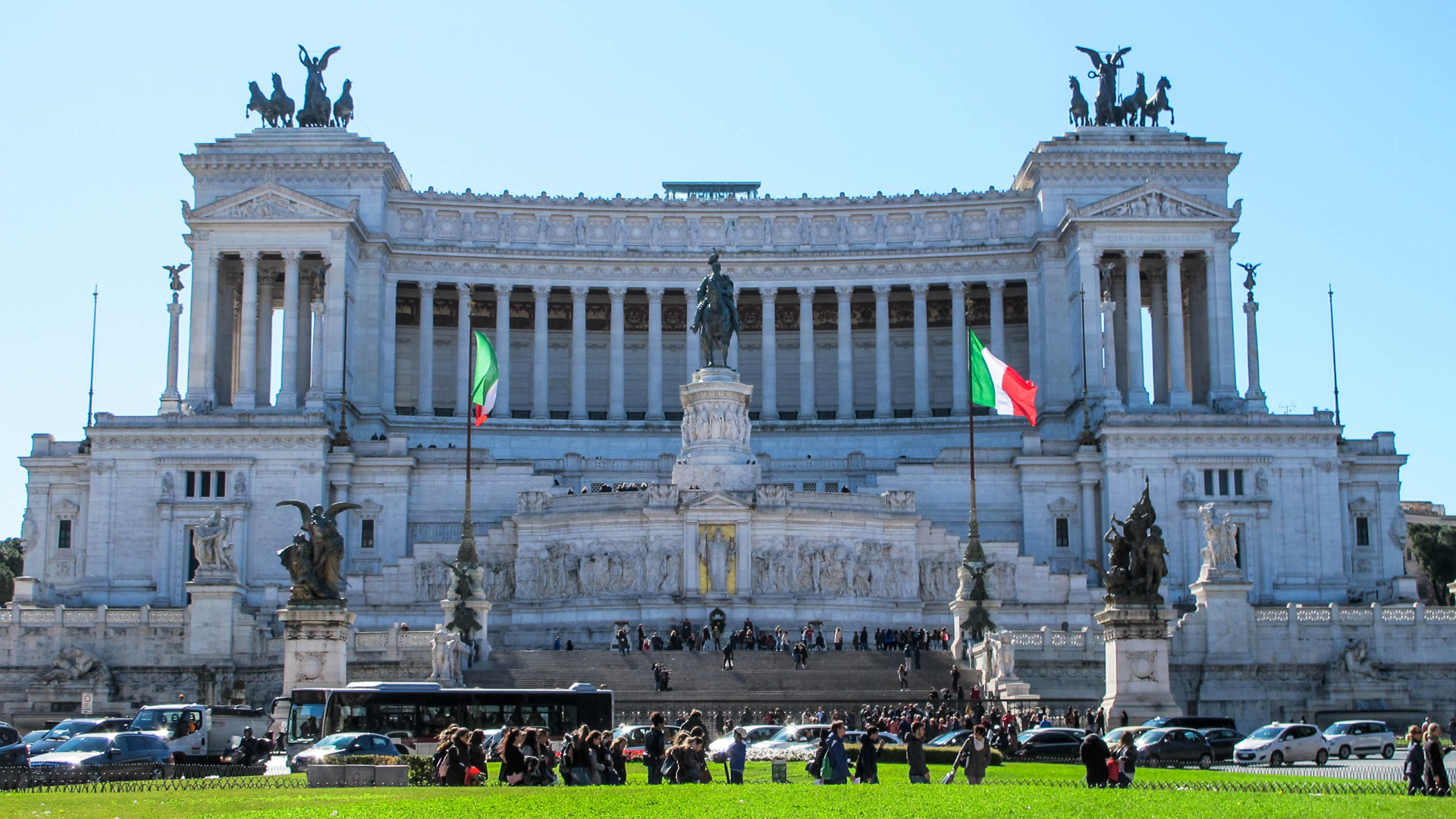
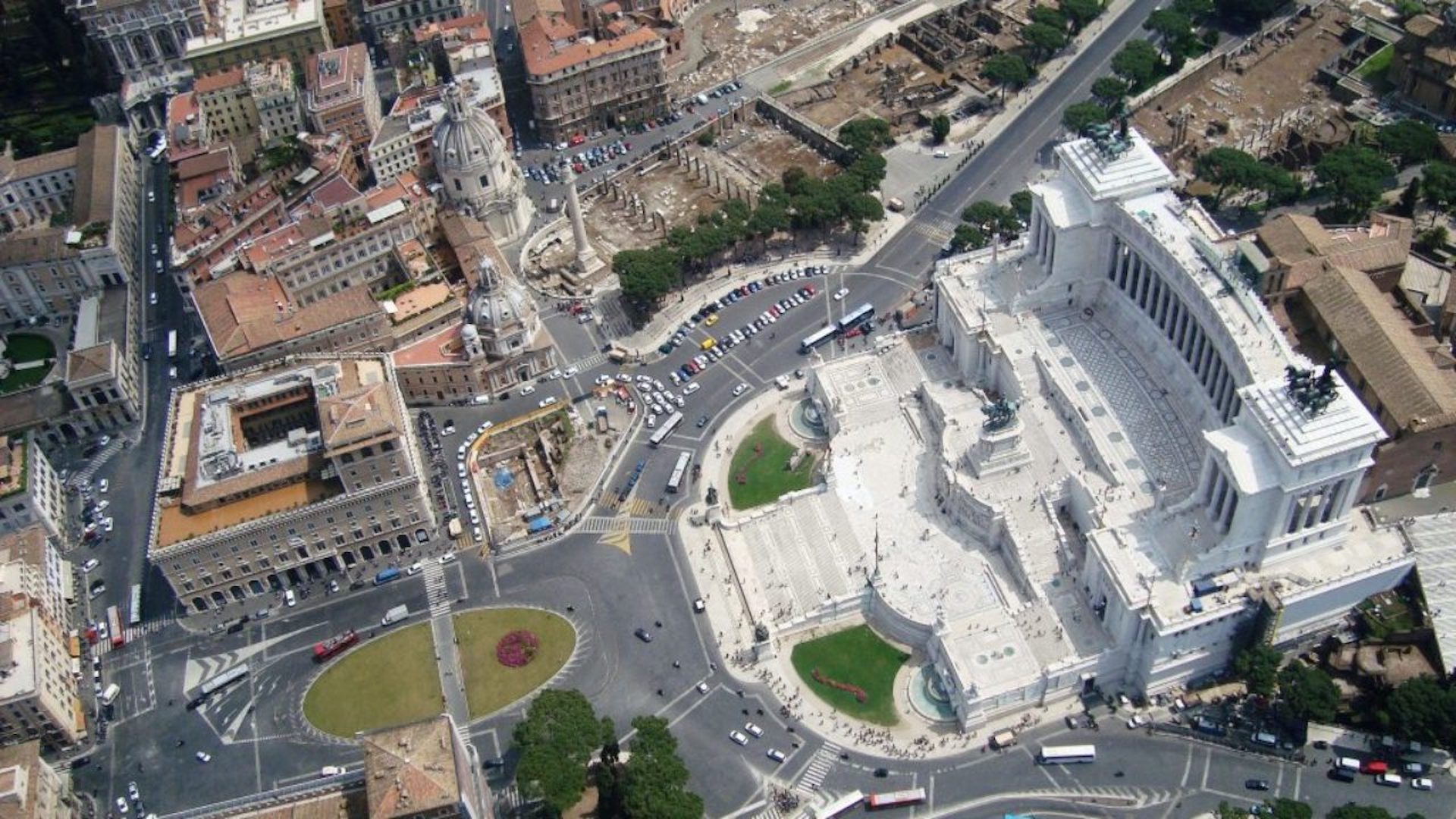
In 1878, a few years after the unification of Italy, the Italian Parliament decided to dedicate a monument to the recently deceased King Vittorio Emanuele II, and with him to the entire Risorgimento season. After having announced two international competitions (in 1880 and 1882), the project by Giuseppe Sacconi, a young architect from the Marche, was chosen, inspired by the great sanctuaries of the classical age: a wide staircase leads to the Altare della Patria, the propylaea and to the grandiose colonnaded portico surmounted by bronze chariots, allegories of the Unity of the Fatherland and of Liberty.
Begun in 1885, the works proceeded slowly and the project was modified several times, also in the choice of material: the travertine was thus replaced with the very white Botticino from Brescia, which does not harmonize well with the warm tones of the surrounding buildings. This feature, combined with its disproportionate size, has earned the complex unflattering nicknames, albeit now affectionate, including that of a typewriter and wedding cake. To make way for the monument, the entire area on the slopes of the Capitol was affected by demolition of the pre-existing medieval and Renaissance districts, including the towers of Paul IV and the cloister of Aracoeli. The Palazzetto Venezia and the Church of Santa Rita were also moved and rebuilt. A small building to the right of the Vittoriano,
Continued by Gaetano Koch, Manfredo Manfredi and Pio Piacentini, the works could be considered completed only in 1935, even if the complex was inaugurated still incomplete in 1911 during the International Exposition for the fiftieth anniversary of the Unification of Italy. On that occasion, the grandiose equestrian statue in gilded bronze dedicated to Vittorio Emanuele II was discovered, the only non-allegorical representation present in the monument: made with 50 tons of bronze obtained by melting the army guns, it is 10 meters long and 12 meters high. Inside the horse's belly, a refreshment was even organized for twenty people to celebrate the success of the work, as evidenced by some vintage photos. The statue of the king is also impressive, just think that his mustache is 1 meter long each.
Under the statue of the Goddess Rome, on November 4, 1921, the body of the Unknown Soldier was buried in memory of the many soldiers who died in the war and whose name or place of burial is unknown. The coffin was placed on the carriage of a cannon and placed in a chariot designed by the architect Cirilli. Between 1924 and 1927 the Quadriga dell'Unità by Carlo Fontana and the Quadriga della Libertà by Paolo Bartolini were finally positioned on the propylaea, bringing the monument to a height of 81 meters from the height of Piazza Venezia.
The central theme of the whole monument is represented by the two inscriptions on the propylaea: “PATRIAE UNITATIâ € ?? and “CIVIUM LIBERTATIâ € ??,“ To the unity of the fatherlandâ € ?? and “To the freedom of citizensâ€, each post almost as a comment on the two quadrigas. On both sides, two fountains represent the Adriatic Sea and the Tyrrhenian Sea and mark the “bordersâ €? of the monument as well as the two seas delimit the Italian Peninsula. Among the decorations, in addition to the winged victories and allegories of the civil values ​​of the Italian people, note the statues of the sixteen Italian regions (in the account are missing the Valle D'Aosta, Friuli Venezia Giulia, Molise and Trentino Alto Adige which were added or created later). Placed on the cornice of the portico, each of them is in correspondence with a column and was entrusted to a sculptor from that same Region.
The monument houses the Central Museum of the Risorgimento and the Shrine of the Flags, which houses the flags of the disbanded Italian army as well as historical pieces such as Luigi Rizzo's anti-submarine MAS 15 motorboat, which sank the Austrian battleship during the Great War Santo Stefano, the wreck of the submarine Scirà © sunk by the British in 1941 off the coast of Haifa, the aircraft “Bleriot XIâ € ?? used in the Italian-Turkish War of 1911-1912 and the 75 \ 27 mod. 12 used during the Great War. The complex also houses exhibition halls used to host temporary exhibitions. Since 2007 it has also been possible to climb to the top of the Vittoriano with a panoramic glass lift: the terrace offers one of the best views of Rome, ideal for taking photos of the imperial forums, the Pantheon,
Every year, on April 25 (anniversary of the liberation of Italy), June 2 (Republic Day) and November 4 (Armed Forces Day), the President of the Republic pays tribute to the unknown soldier by placing a laurel wreath, to I remember all those who died for the homeland. A flame burns incessantly guarded by impassive guards of honor.