 20 Minutes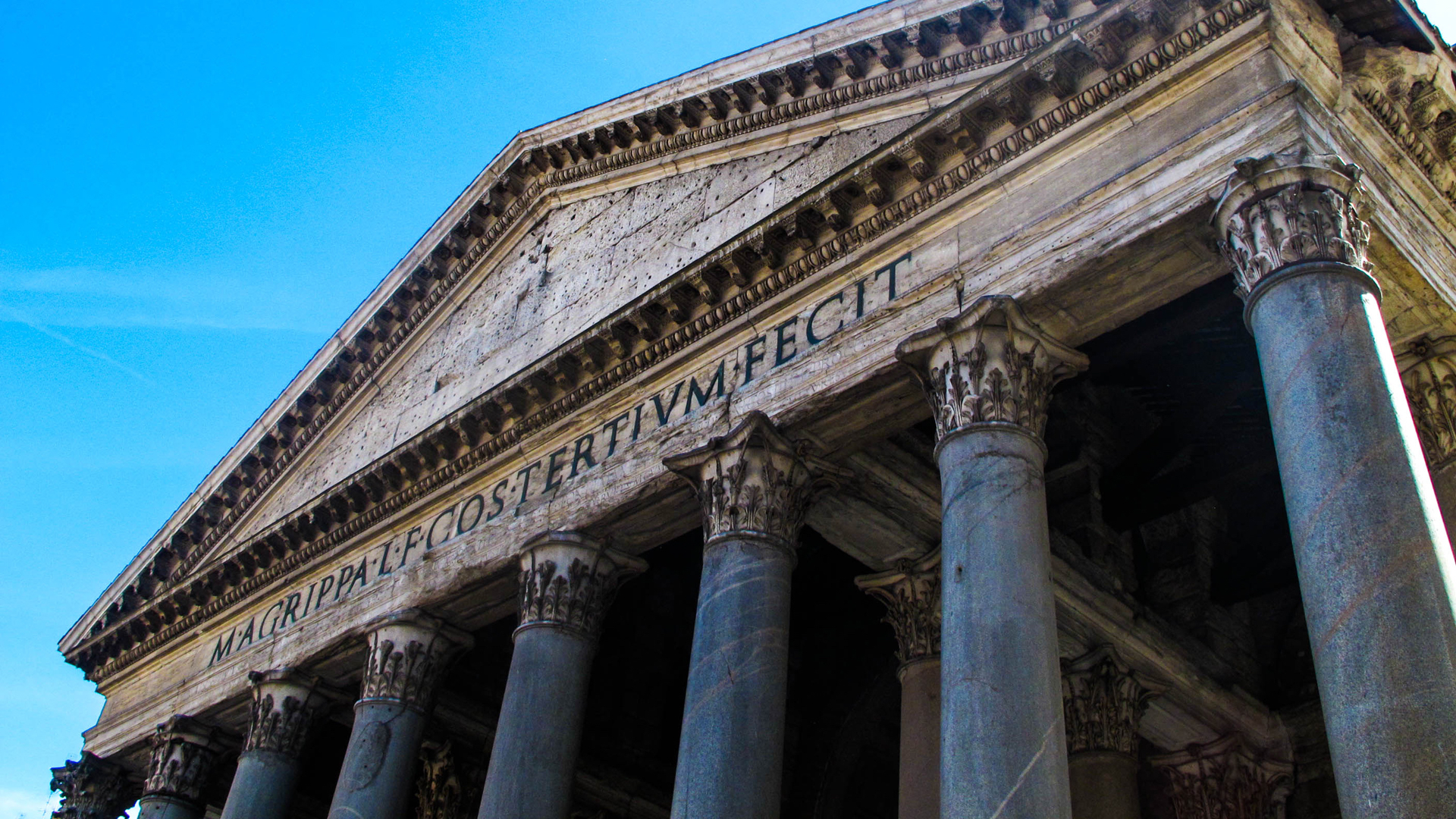
"The most beautiful remnant of Roman antiquity. A temple that has suffered so little that it appears to us as the Romans must have seen in their time", as the French writer Stendhal described it in the nineteenth century. Source of inspiration of the greatest architects of all ages and always admired for its beauty, harmony of lines and perfect calculation of the geometries of the masses, the Pantheon is in fact one of the best preserved examples of Roman monumental architecture.
Its history begins in 27 BC, when Marcus Vipsanius Agrippa, son-in-law, friend and collaborator of Augustus, had a first temple built in this area dedicated to “all the godsâ€. The current form, however, is due to Hadrian who had it rebuilt between 118 and 125 AD, enlarging it, reversing its orientation and opening a large arcaded square in front of the new temple.
Fallen into a state of neglect and subsequently sacked by the barbarians, in 609 AD it was donated by the Byzantine emperor Phocas to Pope Boniface IV who consecrated it by dedicating it to Santa Maria ad Martyres and thus preserving it from the looting that affected many other ancient monuments in medieval times . In 1625, under the pontificate of Urban VIII Barberini, it was deprived of the bronze covering of the portico to melt the canopy of San Pietro and 80 cannons destined for Castel Sant'Angelo. From the episode originated the famous saying, entrusted to the talking statue of Pasquino: “Quod non fecerunt barbari, fecerunt Barberiniâ € ??. In the same years, two bell towers were built on the sides of its pediment, which the Romans called in contempt "donkey ears". and which were removed with the unification of Italy.
The building is composed of a cylindrical structure preceded by a portico with Corinthian columns that support the pediment; the original inscription with the dedication to Agrippa is preserved on the frieze of the entablature. The large circular cell is surrounded by thick masonry walls and eight large pillars on which the weight of the characteristic hemispherical concrete dome, larger than that of St. Peter's Basilica, is distributed. What is most surprising about the architecture of the Pantheon are its dimensions: the height of the building is equal to the diameter of the dome, just over 43 meters, a feature that reflects the classical canons of rational Roman architecture.
The internal part of the dome is decorated with five orders of 28 coffers (a number considered perfect because it is given by the sum 1 + 2 + 3 + 4 + 5 + 6 + 7) which are narrowing upwards. In the center there is an oculus of 8.92 meters in diameter, which allows natural light to penetrate and illuminate the entire building. On the summer solstice, the ray of sunlight that enters from the large eye of the dome projects a huge luminous disc on the floor, equal in diameter to that of the oculus. In case of rain the water enters the Pantheon and disappears in the 22 almost invisible holes on the floor, mostly original and made up of squares and rounds of porphyry, ancient yellow, granite and pavonazzetto.
On the day of Pentecost, every year, a shower of rose petals falls from above inside the Pantheon at the end of the celebration of Corpus Domini.