 7 Minutes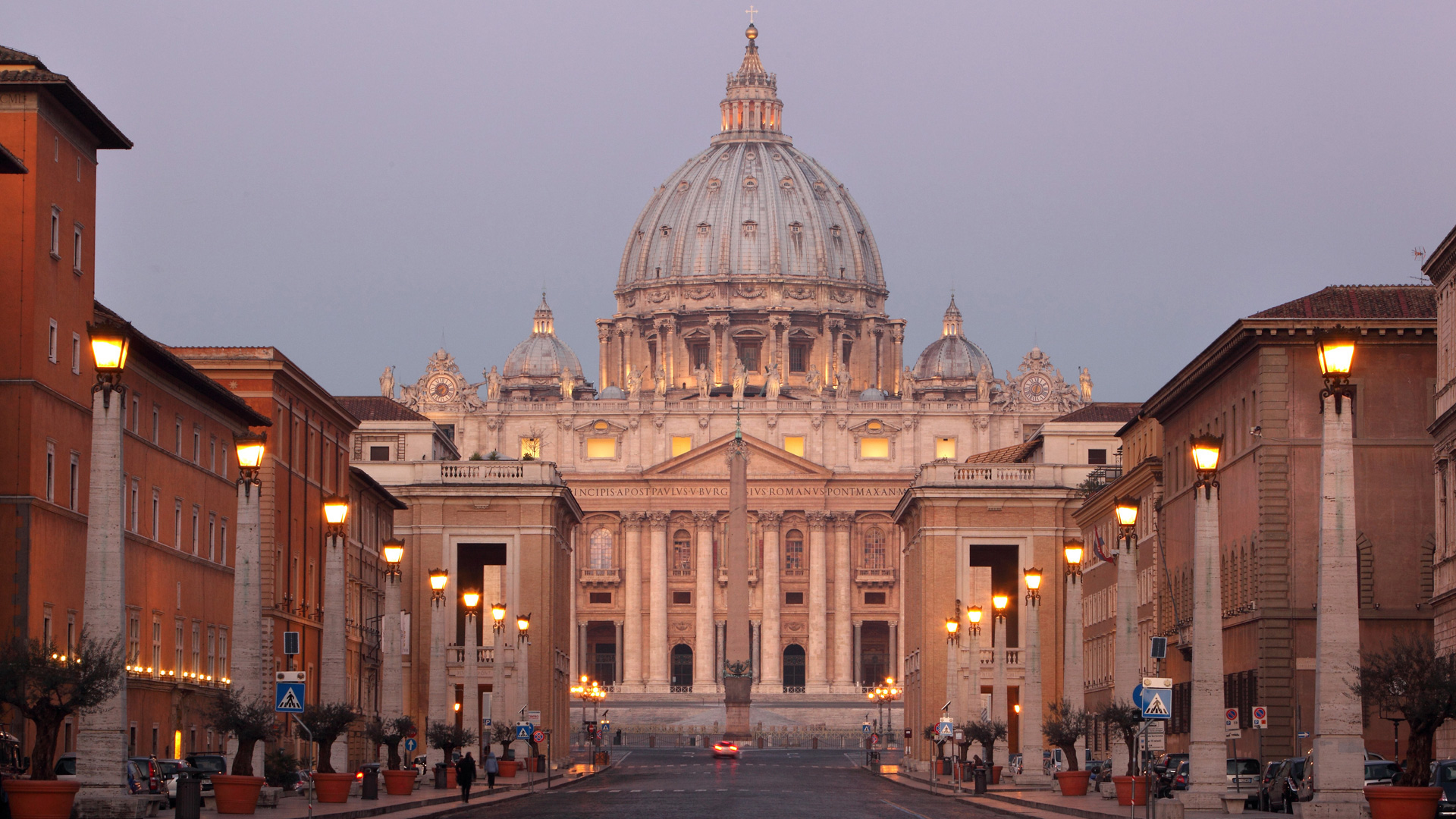
Dominated by the majestic St. Peter's Basilica, Piazza San Pietro owes its characteristic elliptical shape surrounded by the imposing colonnade to the work of Gian Lorenzo Bernini, who welcomes millions of pilgrims and tourists from all over the world into a symbolic embrace every year.
Every Sunday, at noon, a large crowd gathers in this square to attend the Angelus Domini and receive the blessing of the Pope who looks out from the window of his study in the Apostolic Palace.
Commissioned by Pope Alexander VII Chigi, the portico consists of 284 columns arranged radially on four rows; gradually decreasing the diameter, Bernini managed to keep the proportional relationships between spaces and columns unchanged even in the external rows.
Thanks to this expedient, positioning on the porphyry discs on the sides of the obelisk, the visitor will see the colonnade composed of a single row of columns.
The obelisk placed in the center of the square by Sixtus V is one of the Egyptian ones transported to Rome at the time of Caligula. This is the ancient "garfish" of the Middle Ages, when it was believed that the ashes of Caesar were deposited on the tip, in a bronze globe (removed by Sixtus V); today, at the top where there is the bronze emblem with the mountains and the star of the Chigi, there is a relic of the Holy Cross.
Located symmetrically in the center of the two hemicycles of the Berninian colonnade and aligned with the Vatican Obelisk, the "almost" twin fountains of St. Peter's Square are due to the ingenuity of two of the major protagonists of the architectural history of this famous square: Carlo Maderno, author of the facade of the Basilica, and Gian Lorenzo Bernini, great exponent of the Roman Baroque and brilliant arranger of the square.